
Table of Contents
Related Articles


Winter Safety Strategies: Proactive Solutions for Reducing Slips & Falls
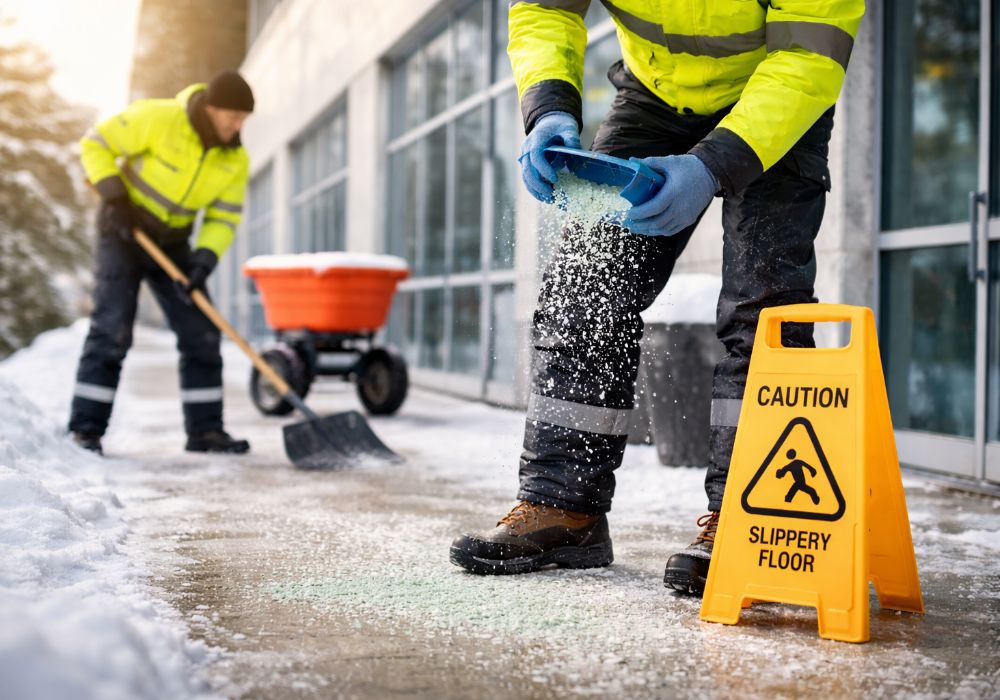
New England weather loves to keep us guessing—mild and sunny one day, bitterly cold the next. Rain or melting snow can create puddles that freeze overnight, forming slick patches of ice. The real danger? Black ice, which is nearly invisible. Add a fresh layer of snow on top, and you’ve got a hidden hazard waiting to cause trouble.
Slipping on ice isn’t just inconvenient—it can lead to serious injuries like head trauma, back injuries, and broken bones. That’s why prevention and proactiveness are key. Start by reminding employees how dangerous these conditions can be, and make sure your facilities team stays ahead of the game by clearing and treating high-risk areas before accidents happen.
Personal Strategies to Address Winter Slips and Falls
When it comes to working safely, each individual is responsible for their own safety. During the winter months, employees should do the following:
Wear Proper Footwear
- Avoid Slippery Soles: Employees should avoid wearing slippery soled footwear when walking outdoors.
- Hazardous Styles: Leather soled shoes, high heels, and Crocs can be even more hazardous in the winter months.
- Traction is Key: Employees should wear boots or shoes that provide sufficient traction.
- Safety Partnerships: ISCC/FutureComp members and clients now have access to exclusive pricing on ShoesForCrews safety footwear—a proven solution backed by NIOSH research.
- Additional Traction: A great first step any organization should consider is to provide employees with additional traction, which can be provided by taking advantage of our partnership with Winter Walking.
Take Extra Care Entering and Exiting Vehicles
- Vulnerability: Getting in and out of a car is a particularly vulnerable time for a slip and fall.
- Weight Distribution: When getting in and out of a car, we are forced to put all our weight on one foot. This transitional posture is less stable than when we have both feet on the ground.
- Stability Tips: Holding on to the car door or steering wheel can help provide extra stability.
Walking on Walkways and Parking Lots
- Pace: Walking at a slower pace can help employees spot hazards.
- The Shuffle: If an employee finds themselves in an icy area, they should do their best to keep both feet on the ground and shuffle to a safe surface.
- Hidden Ice: Extra caution should be used when the surface is covered with snow.
Administrative Strategies: Signage and Awareness
- Temperature-Sensitive Reflectors: Adding these at entrances, walkways, and parking areas provides a simple yet highly effective way to alert staff, students, and visitors when surfaces are approaching freezing conditions. These reflectors change color as temperatures drop, offering an immediate visual cue.
- Safety Awareness Signage: Installing additional safety awareness signage is a simple way to prevent injuries. Clear, visible signs remind employees and visitors to watch for icy surfaces, slow down, and report hazards.
Funding Your Safety Initiatives: 2026 Health & Safety Grant
All Members are encouraged to submit an application for up to $5,000 in funding through the Health & Safety Grant Program for the 2026 Enrollment. Don’t miss out on this valuable opportunity to enhance your institution’s safety measures.
- Plan Ahead: Start planning your 2026 Health and Safety application today.
- Learn More: Visit the ISCC’s Video Library for member testimonials.
- Contact: Reach out to Loss Control Consultant Zachary Collins at Zachary.Collins@usi.com or 603-665-6056.
Facilities Strategies: Beyond Typical Snow Removal
As our facilities are situated in New England, snow and ice mitigation is a constant challenge. There are several ways an organization can attack this serious hazard that go beyond snow shoveling and plowing. Below are some processes that facilities can utilize that can mitigate slips and falls hazards during the winter months. For additional information and resources please visit our Safety Blog Library, or contact Loss Control Consultant.
Liquid Pre-treatment Solutions
Applying a deicing product to parking lots and walkways before a snow or ice event significantly reduces the formation of “black ice.” This also reduces the need for salt and sand, which often get tracked into buildings and create secondary slip hazards.
- Ice B’Gone Magic: At least one member successfully uses this product.
- Calcium Chloride: Provides melting power when temperatures drop as low as -25ºF (-31.6ºC). It is much more effective than rock salt and is often the most cost-effective option for pavement and the environment.
- Magnesium Chloride: Preferable when there is a danger of salts washing into nearby landscaping, though it can become slippery if applied too heavily.
- Calcium-Magnesium Acetate: While not as powerful as other anti-icers, it is adequate for most situations and avoids corroding steel structures.
The Advantage of Snow Brushes
Snow brushes have become a key component of many ISCC facilities managers’ winter maintenance programs. They clear snow effectively and expose pavement to sunlight, reducing the chance for residual ice to form.
- Effectiveness: Even on cloudy days, removing the thin layer of snow left by a plow can prevent that film from freezing into a slick surface.
- Maneuverability: Portable, battery-powered lightweight models allow staff to easily maneuver in tight spaces—such as narrow walkways, stair landings, and entryways—where larger equipment cannot reach.