
Table of Contents
Related Articles

Safer Campus Vehicles: Best Practices for Golf Carts and Utility Vehicles
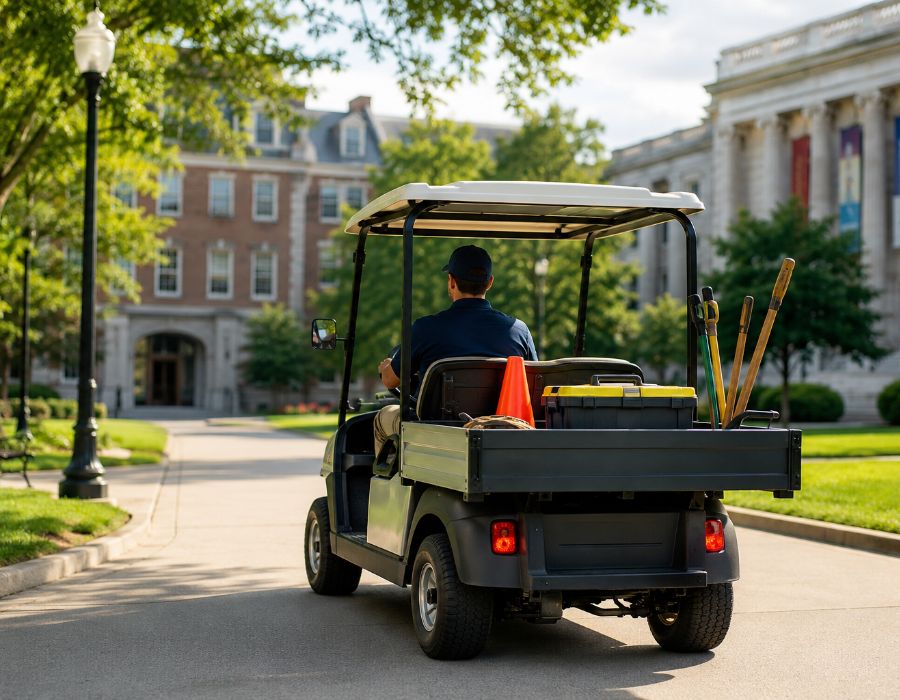
On a large campus, staff are constantly moving from one area to another. In schools, museums, and other spread-out workplaces, golf carts and utility vehicles help people cover ground efficiently. But when these vehicles become part of the daily routine, safety can start to slip.
That is where risk begins.
A cart that tips on uneven ground, a distracted driver near pedestrians, or an overloaded vehicle can quickly lead to a serious injury and a costly workers’ compensation claim.
Low speed does not mean low risk. Golf carts and utility vehicles still require training, attention, and clear operating rules. When employees assume these vehicles are harmless, they are more likely to take shortcuts that put themselves and others in danger.
A strong safety program starts with consistent expectations. Every employee who operates a campus vehicle should receive basic training before getting behind the wheel. That training should cover safe driving practices, passenger limits, loading rules, and how to avoid pedestrian traffic.
A few simple safeguards can reduce risk right away:
- Require every operator to complete documented training before use.
- Limit passengers to the number the vehicle is designed to carry.
- Keep keys controlled when vehicles are not in use.
- Avoid busy pedestrian paths whenever possible.
- Report damage, near misses, or unsafe driving immediately.
Route Planning and Changing Conditions
Those basics matter, but they are only part of the picture. Campus vehicles are often used in places where foot traffic, weather, and terrain change throughout the day. A route that feels safe in the morning may be crowded by afternoon. Wet pavement, gravel paths, narrow turns, or low visibility can all make a routine trip more dangerous than it seems.
That is why route planning should be part of every campus vehicle policy. Some walkways and shared spaces are not appropriate for motorized traffic, especially during busy hours. Clear approved routes can help prevent avoidable incidents and reduce confusion across campus. It also helps to identify no-go zones where pedestrians always have the right of way.
Managers should also pay attention to how vehicles are loaded. Overloading a cart with equipment, supplies, or too many passengers can affect balance, steering, and braking. Even a small shift in weight can make the vehicle harder to control. Staff should understand that if a load feels awkward or unstable, it probably is.
Inspections, Distractions, and Consistent Safety Practices
Regular inspections are another important step. Tires, brakes, lights, steering, and batteries should be checked on a routine basis. A vehicle that is not working properly can create a hazard even when the driver is careful. If something looks wrong, the vehicle should be taken out of service until it is repaired.
It is also worth reminding staff that distractions are not limited to cell phones. Talking with passengers, carrying paperwork, checking messages, or rushing to the next task can all pull attention away from the path ahead. On a campus, where people may be walking around buildings, corners, or parking areas, a few seconds of distraction can be enough to cause harm.
A safe vehicle program works best when it is simple, clear, and enforced consistently. Employees should know who can operate the vehicle, where it can be used, and what rules apply every time they get behind the wheel. When expectations are consistent, safety becomes part of the routine instead of an afterthought.
When a campus vehicle policy is simple, clear, and enforced, it protects both people and operations. A few practical safeguards can go a long way toward preventing injuries and keeping staff safe as they move across campus. For schools and cultural institutions, that kind of prevention supports a safer workplace and helps reduce the chance of avoidable workers’ compensation claims.